The New York Times profiled MEDVi. The FDA had already warned them.
Every figure below was read from its source on April 15, 2026. Live prices move; this page does not.
The Times called it an AI success story. The FDA had already sent a warning letter. Here is what actually happened, and what it means for anyone buying research peptides.
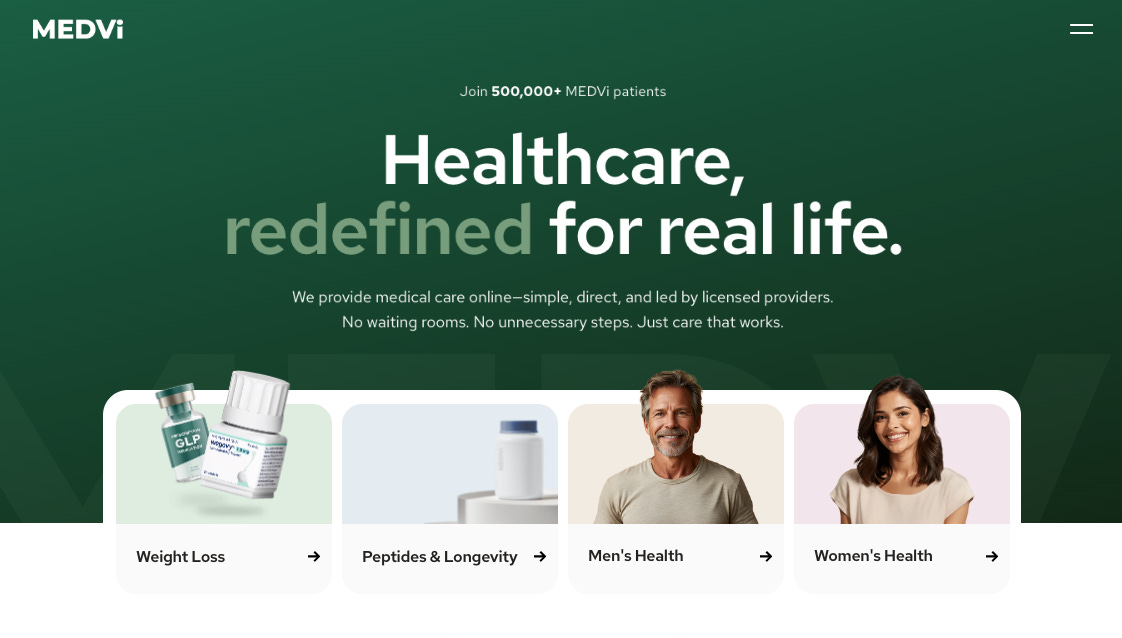
MEDVi's homepage promised "Healthcare, redefined for real life." The FDA had already issued a warning letter for misleading product claims.
What MEDVi actually did
In April 2026 the New York Times published a glowing profile of MEDVi, a telehealth company that had reportedly built a $1.8 billion business selling GLP-1 weight loss drugs with AI tools and a two-person operation. The headline framed it as a story about where AI entrepreneurship was heading.
What the profile did not lead with: the FDA had already sent MEDVi a formal warning letter. Business Insider had already reported hundreds of fake doctor accounts created to work around Meta's healthcare advertising restrictions. And regulators had documented a pattern of misleading claims designed to make customers believe they were getting something they were not.
The real story is not about AI. It is about what happens when a company in an unregulated gray market decides that growth matters more than honesty, and what that costs the customers who trusted them.
Based on subsequent reporting from Business Insider, Drug Discovery Trends and eMarketer:
- Fake doctor accounts at scale. MEDVi created over 800 fake Facebook doctor personas to advertise its products. Meta's advertising policies restrict healthcare companies from making certain medical claims, and the fake doctor accounts were a direct workaround. At peak, MEDVi was running more than 5,000 simultaneous Meta ads through this network. After Business Insider exposed the operation, that number dropped to roughly 2,800. The accounts were not a rogue tactic. They were the core acquisition engine.
- AI-generated testimonials and before/after photos. MEDVi used AI-generated or altered images as customer testimonials. In a category where social proof is a primary purchase driver, fabricated results are a meaningful form of consumer deception.
- An FDA warning letter for misleading product claims. The FDA issued a formal warning letter to MEDVi for falsely implying that its compounded drugs were FDA-approved and that the company compounded its own medications. Neither was true. The letter required MEDVi to correct the record.
- Media logo deception. MEDVi displayed media logos in an "as seen in" format that regulators characterised as misleading, implying endorsement where none existed.
None of this appears in the NYT profile in any detail. The piece presented MEDVi as a scrappy AI startup with a clever idea. The regulatory and investigative record tells a different story.
Why this keeps happening in the peptide and GLP-1 space
MEDVi is not an anomaly. It is a predictable outcome of how this market works.
Research peptides and gray-market GLP-1 compounds exist in a regulatory gap. They are legal to sell "for research purposes", but they are widely purchased and used by people seeking weight loss, injury recovery, hormone optimisation and other real health outcomes. The companies selling them are not subject to the same FDA oversight as pharmaceutical companies, and many of them know it.
The result is a market where:
- Vendors can say almost anything without meaningful consequences.
- Purity claims are self-reported. A vendor testing their own product is like a student grading their own exam.
- Pricing is deliberately confusing. Vials of different sizes, bundles, membership pricing and hidden shipping costs make an apples-to-apples comparison nearly impossible.
- Fake social proof is widespread. Forums, subreddits and review sites are routinely seeded with vendor-affiliated accounts.
Most buyers have no way to tell a legitimate vendor from a bad actor. The barrier to looking trustworthy is a nice website and a stock photo of a lab. The barrier to actually being trustworthy, meaning published third-party purity tests, competitive pricing and standing behind your products, is much higher. Most vendors choose the former.
MEDVi operated at much larger scale than a typical research peptide vendor, but the tactics are structurally identical to what happens throughout this space every day.
The specific tactics that harm buyers
It is worth being concrete about what deceptive practices actually cost people buying in this category.
- Fake purity documentation. A vendor can produce a Certificate of Analysis showing 99% purity on any compound they want. If they generated it themselves, it is worthless. Buyers who make purchase decisions on self-reported COAs have no idea what is actually in their vials.
- Inflated pricing with no quality backing. Some vendors charge three to four times the market rate while providing no third-party testing to justify the premium. The implicit promise is quality. The reality, when tested by a third party, is often identical or worse purity compared to cheaper alternatives.
- Fabricated reviews and community presence. A vendor that seeds forums and review platforms with fake positive reviews systematically degrades the information environment buyers rely on. Every fake review pushes real information further down.
- Authority signals without substance. MEDVi's use of misleading media logos is a specific version of a broader pattern: displaying credibility signals that were not earned. In a category with no natural authority figures, buyers default to whoever looks most legitimate.
These are not minor marketing exaggerations. For people making health decisions based on vendor claims, the stakes are real.
What actually matters when choosing a vendor
The MEDVi story is useful because it clarifies what trustworthiness looks like, as opposed to the performance of it.
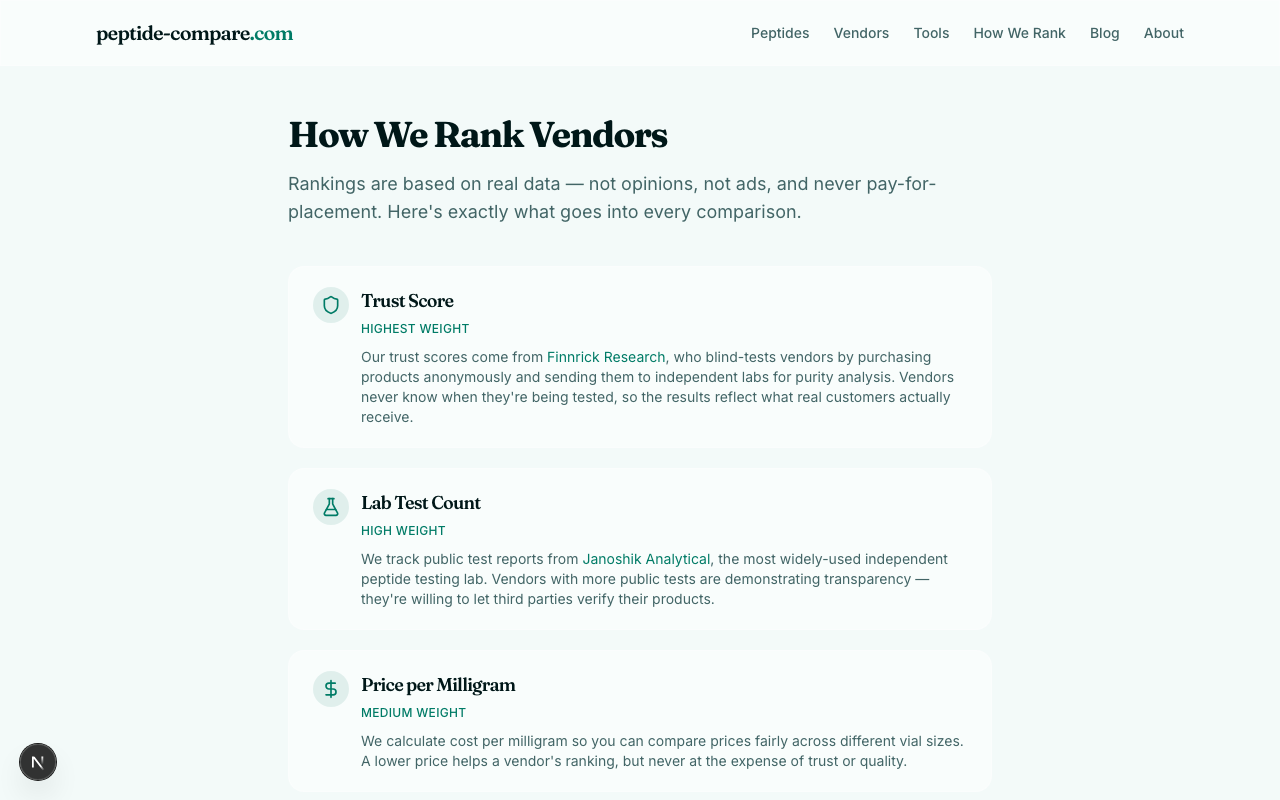
Peptide Compare ranks vendors using Finnrick blind test scores and Janoshik lab data, third parties with no financial stake in the outcome.
- Third-party purity testing. The two sources that matter are Finnrick Research, which runs blind anonymous purchases and sends samples to accredited labs, and Janoshik Analytical, a Czech lab where vendors voluntarily submit products for public testing. A vendor with a Finnrick blind test score above 8.0 has been verified by someone with no financial stake in the outcome. That is a meaningfully different signal from a vendor-produced COA.
- Price transparency at the unit level. A vendor that shows price per milligram across standardised vial sizes is operating honestly. Price per mg is the only fair comparison. A vendor that forces you to compare a 5mg vial to a 10mg vial without doing the maths is, at minimum, making your decision harder on purpose.
- Verifiable community history. Real reputation in forums and subreddits
takes years to build and is hard to fake at scale. Searching
site:reddit.com "[vendor name]" peptidesurfaces actual customer experiences. A vendor with zero organic community presence despite claiming years of operation is a flag. - No unverifiable medical claims. Any vendor implying their products are FDA-approved, clinically proven or equivalent to pharmaceutical-grade products without documentation is making claims they cannot support. MEDVi's FDA warning letter was for exactly this. It is not a rare problem.
The broader lesson
The NYT profile of MEDVi will fade. Search traffic around "MEDVi fake doctors" and "MEDVi FDA warning" will eventually decline. But the conditions that made MEDVi possible do not go away: a gray market with no accountability mechanisms, buyers who cannot easily verify vendor claims, and a race to the bottom in which deceptive tactics outperform honest ones.
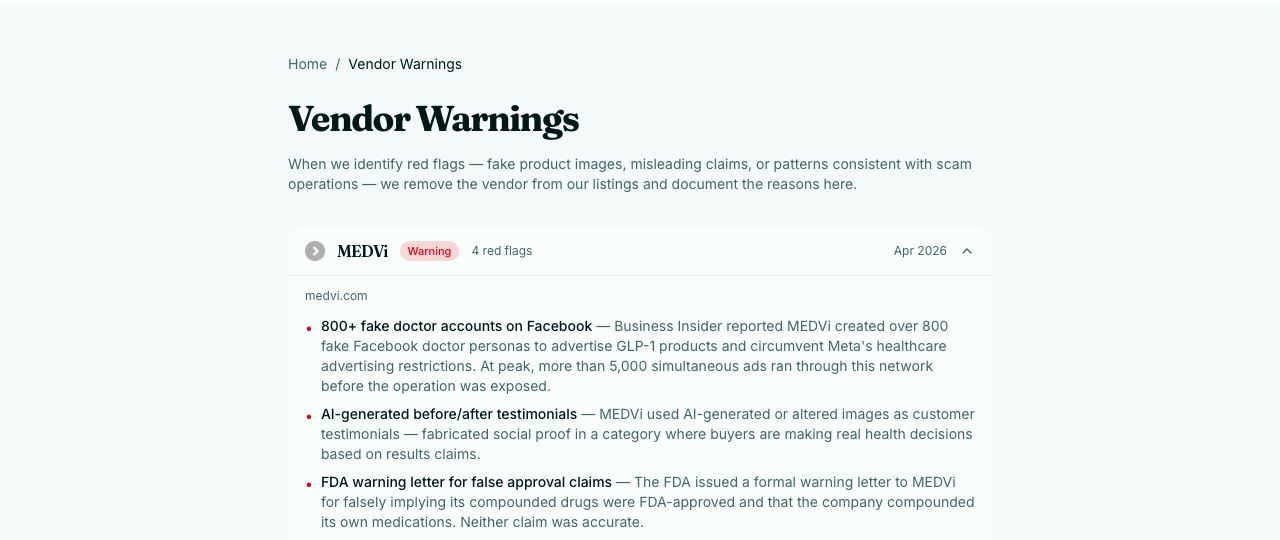
Where vendors demonstrate misleading claims or scam patterns, Peptide Compare documents it publicly, which is the opposite of MEDVi's fake credibility signals.
What changes the market is information. Not more marketing, not better website design, not AI-generated authority signals, but actual data. Third-party purity test results. Scraped pricing normalised to price per milligram. A published ranking methodology that no vendor can pay to influence.
That is what we built at Peptide Compare. We earn affiliate commission when a reader clicks through to a vendor, and that is exactly why the ranking inputs are published and exclude any commercial term: buyers in this space are making real decisions with real consequences.
The best vendor for any peptide is not the one with the best ads or the most convincing website. It is the one with the data behind it.
Common questions
- Did MEDVi receive an FDA warning letter?
- Yes. The FDA issued a formal warning letter over claims that implied MEDVi's compounded drugs were FDA-approved and that the company compounded its own medications. Neither was the case, and the letter required MEDVi to correct the record.
- What were the MEDVi fake doctor accounts?
- Reporting documented more than 800 fabricated Facebook doctor personas used to promote MEDVi products, which worked around Meta's restrictions on healthcare advertising claims. At peak the network ran more than 5,000 simultaneous Meta ads; that fell to roughly 2,800 after the operation was reported.
- What should a buyer check instead of marketing claims?
- Third-party purity testing from a lab with no stake in the result, price stated per milligram so vial sizes can be compared, a community history that would take years to fake, and the absence of medical claims the vendor cannot document.
Sources
- How A.I. Helped One Man (and His Brother) Build a $1.8 Billion Company — The New York Times, read Apr 15, 2026
- The New York Times spotlighted MEDVi. The FDA had already warned the self-proclaimed fastest-growing company in history. — Drug Discovery Trends, read Apr 15, 2026
- Fake doctor ads fuel scrutiny of GLP-1 marketer — eMarketer, read Apr 15, 2026
- AI hype meets consumer healthcare: MEDVi and GLP-1s — Fitt Insider, read Apr 15, 2026